FF Group Officially Joins Axis Communications
Learn more →
LPR technology has been around for decades, and at FF Group we have been working with it for more than 15 years. Over this time, LPR has evolved rapidly. It’s not only speed, precision, and accuracy that are improving, the very way the technology works and is understood is changing.
Historically, LPR was about detecting symbols and interpreting regional templates to correctly read license plate text. If no symbols or no plate were detected, the database returned no result, which for the LPR system user meant no vehicle existed. To increase the probability of detection, LPR software manufacturers introduced strict requirements: correct angles, proper plate size, limited speed, sharp images without blur, and so on.
But what if the software didn’t need a license plate at all in order to detect a car?
Before diving deeper, let’s clarify what we mean by no plate detection. This is a product feature in LPR software where a license plate is not required to fully detect and recognize a vehicle. Traditionally, most LPR solutions rely on a visible plate to confirm the presence of a car. With the “no plate detection” feature, however, applications like CAMMRA AI from FF Group can detect and correctly classify vehicles even when the plate is missing or not visible.
There are multiple situations that may be considered “no plate detection”:
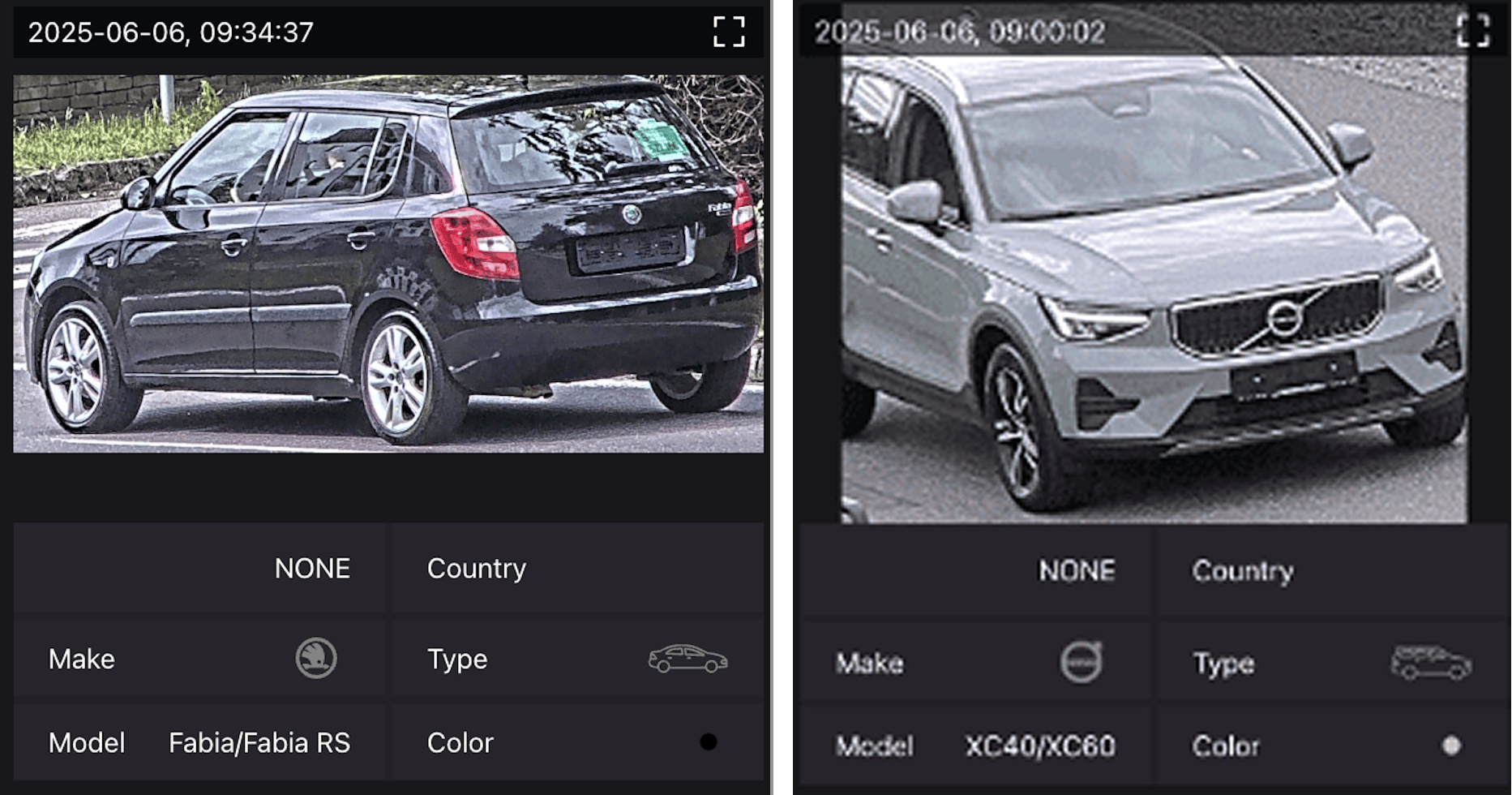
Case A: A vehicle is in the ROI without a real license plate. A real license plate means a valid vehicle registration number. If something plate-like is present but without proper structure—such as the empty white rectangle on a silver Kia or the black rectangle with a Volvo logo on a silver Volvo—this is not considered a real plate.
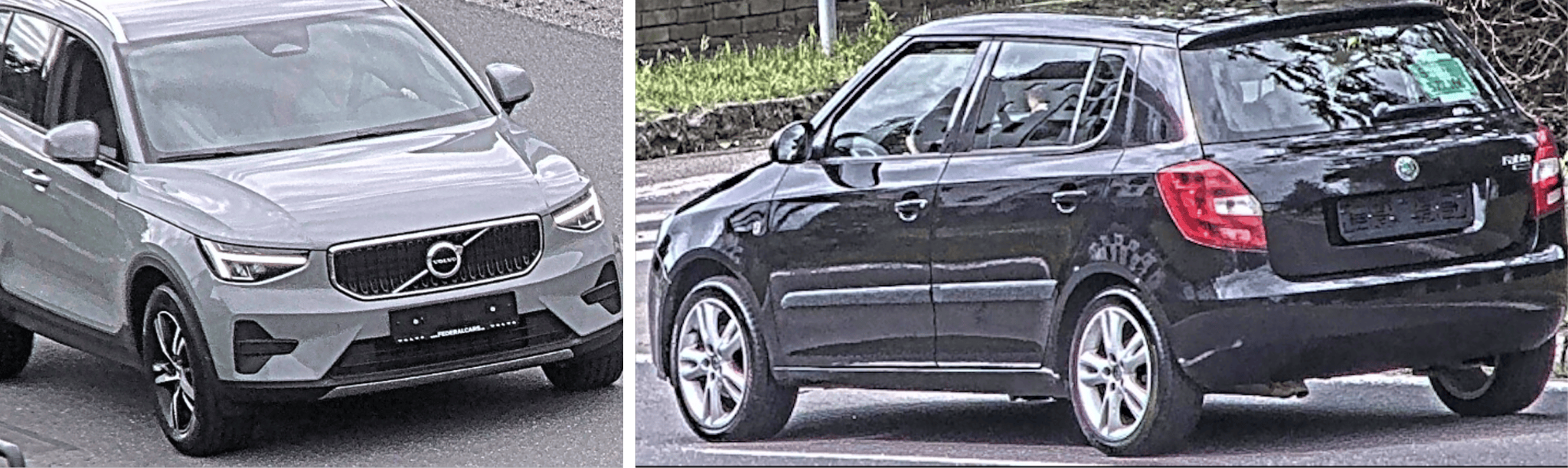
In this situation, the LPR application should still provide results for the vehicle.
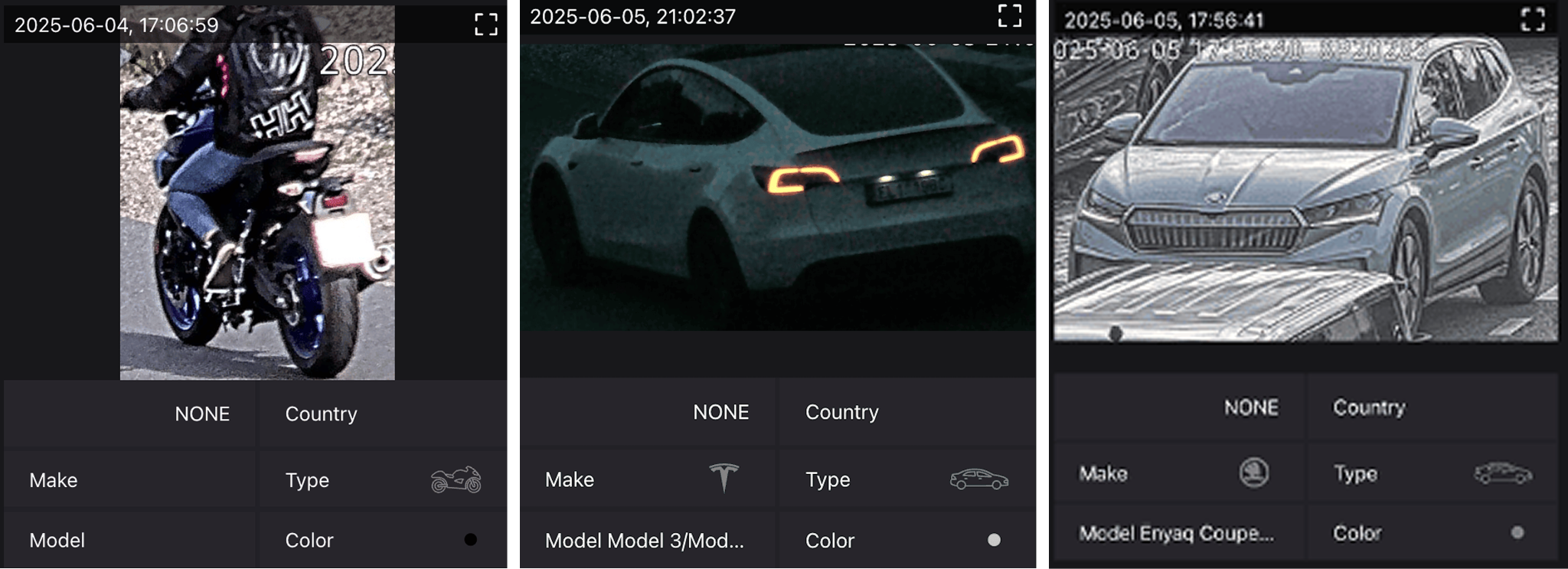
Case B: A real license plate exists but is not visible at the moment of detection or recognition, and therefore cannot be detected or recognized. This occurs when a plate is strongly overexposed (for example, on the motorcycle shown) or obstructed (like on the Škoda Enyaq). Sometimes, due to lighting conditions or incorrect camera calibration, the plate may also be blurry and therefore unreadable.
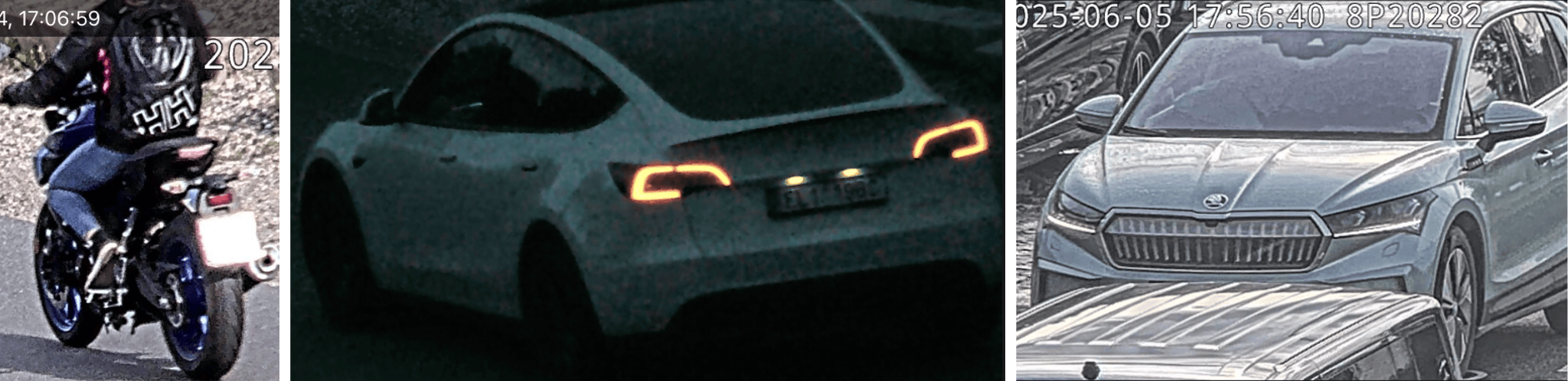
Currently, LPR software displays such cases simply as “no plate.” However, more detailed classification could be introduced, with subclasses such as obstructed plate or unreadable plate.
Case C: A plate is present in the ROI but only partially visible. Right now, most LPR software provides a result if it can read at least part of the plate. If not, it is displayed as “no plate.”

Different manufacturers take different approaches here. At FF Group, the philosophy is clear: no vehicle should be missed. It is better to detect and capture something partially correct than to miss it entirely.
The importance of this feature depends on regional conditions, yet many still assume that cars without plates are extremely rare.
Take motorcycles as an example: they typically don’t have front plates, so when viewed from the front they are usually missed by many LPR cameras. Depending on the region, this can mean anything from 2% in New Zealand to 96% in Vietnam of registered vehicles are undetectable by front-facing LPR. Naturally, in countries with the highest share of motorcycles such as Vietnam, Indonesia, Thailand, the Philippines, Bangladesh, and Sri Lanka, rear installation of LPR cameras is the only logical choice.
Some of this can be avoided by using a rear-plate view, but other statistics are just as revealing. In the U.S., national estimates suggest 1–3% of vehicles are driven unregistered or with expired registration. In high-violation areas such as large cities or border zones, this can climb to ~5%. An unregistered car automatically means no valid plate. Even registered vehicles may appear plate-less in situations such as:
Adding in common LPR challenges such as dirty, bent, or covered plates, poor lighting, or bad camera angles adds another ~1–5% of vehicles that may be undetectable at any given moment.
Altogether, this means 4–10% of vehicles on U.S. roads might appear plate-less. In other regions, the situation can be better. For example, in the Czech Republic, where both front and rear plates are legally required, missing plates occur mostly due to theft or accidents. Official statistics show about 0.2% of cars lack a plate, which is 2 cars per 1,000. With free-flow LPR cameras registering thousands of vehicles daily, this still translates into 20–30 missed cars per camera per day.
At an intersection near our office, for instance, 3,000–4,000 cars are detected daily, and about 10 of them appear without a proper license plate. This results in around 280 vehicles per month per camera.
Since some drivers deliberately avoid being identified, such cases should be of particular interest to law enforcement and traffic authorities.
Combining MMR (Make, Model, Color) with vehicle fingerprinting is becoming increasingly important to close this gap. A single piece of information such as “car without a plate detected” does not provide enough context, and without additional attributes it creates unnecessary manual workload.





.svg)